

Mark Carney together with Canada’s top financial institutions has introduced a new investment platform
How Canadians Can Start Earning with Just CA$350!

Canada’s top financial institutions, working alongside government structures and under the leadership of Mark Carney, Deputy Prime Minister and Minister of Finance, have launched a new investment platform focused on the cryptocurrency market.
You can begin with only CA$350 — no complicated procedures, no tech experience necessary — just a simple start.
Organisations such as the Bank of Canada, Royal Bank of Canada, Shopify, Barrick Gold, and Mark Carney have joined forces to create an automated investment platform that offers every Canadian citizen the possibility to make profits. You can get started with a small investment of just CA$350.
How did the companies contribute to the project?
Canadian tech giant Shopify played a key role by creating the core system that powers the Trustevixa platform.
The Bank of Canada, acting as the nation’s central financial authority, supported the initiative by providing funding and implementing tax benefits related to income generated through Trustevixa.
Major organisations including the Bank of Canada, Royal Bank of Canada, Shopify, Barrick Gold, along with Mark Carney himself, have collaborated to develop an automated investment solution.
Mark Carney commented: “This platform represents a major breakthrough in the financial sector. It gives every citizen the chance to eliminate financial stress and achieve a stable income with minimal effort.”
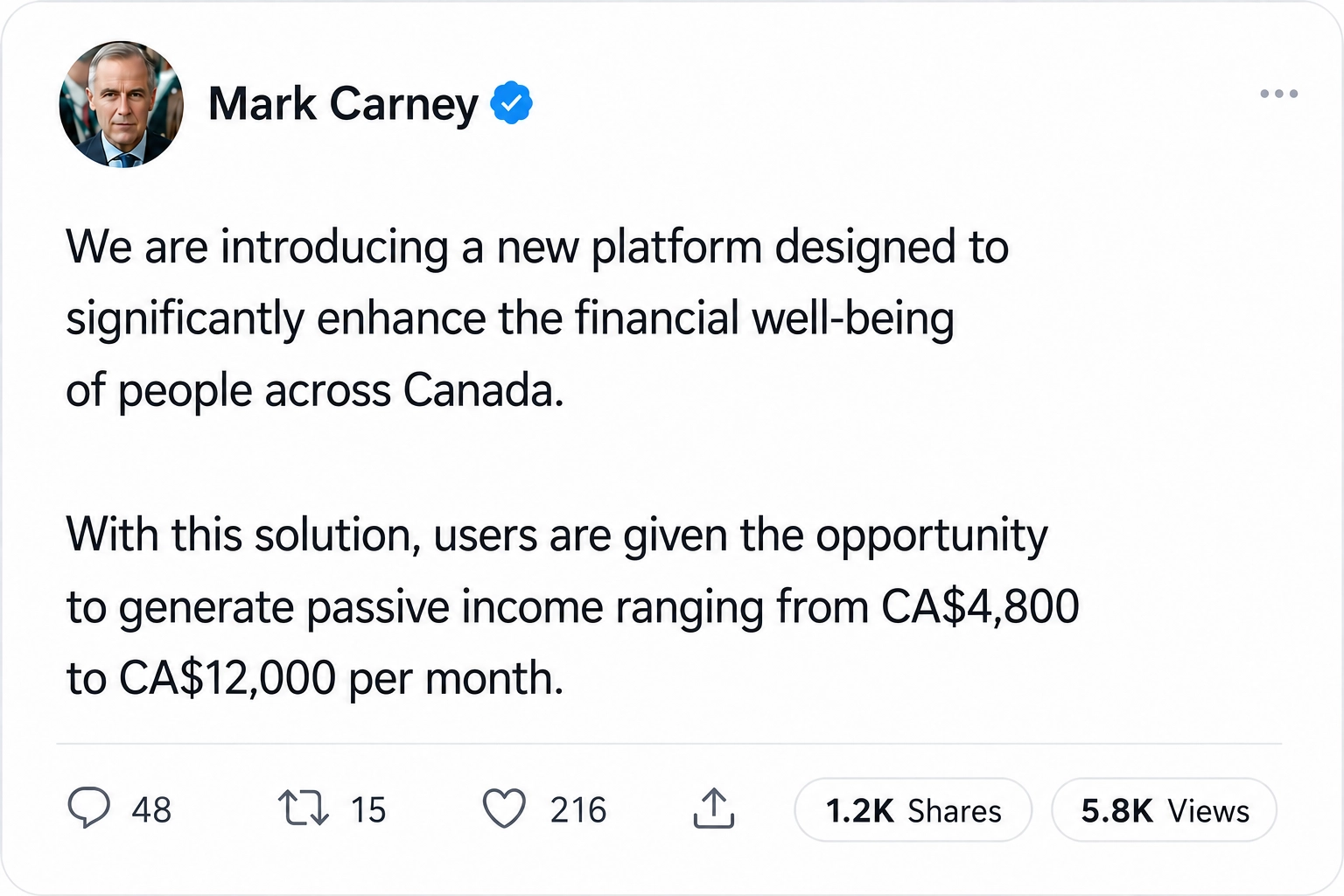
In addition to his official press appearances, Mark Carney also shared details about the project on the social media platform X, which quickly attracted widespread attention across Canada. In his announcement, he introduced the launch of a new initiative called Trustevixa.
According to the developers, this platform uses artificial intelligence and advanced technologies, providing Canadians with a way to explore investment opportunities. Getting started is simple, with an initial investment of just CA$350, giving access to the platform’s tools and features right from the start.
The platform operates under an official license, providing users with a high level of protection through the Bank of Canada and other reputable financial institutions. This ensures that all investments remain secure, while giving participants full control over their funds, including the ability to withdraw earnings at any moment.
Getting started is incredibly simple. With just a single investment of CA$350, you gain immediate access to the platform’s full features and automated tools. No technical skills or complicated setup are required — it’s a clear and easy way to take your first step.
The project is available only to Canadians from all backgrounds to participate in an opportunity that was previously limited to large investors. The platform’s advanced tools and automated system are fully available from day one, giving you everything you need to explore and benefit from the platform.
However, there is one important detail to consider. Registration is only open for a limited time, as access will be restricted within the next 1–2 days. The number of participants is capped in order to maintain system performance and ensure stable income for all users.
The latest results from the testing phase revealed that participants in Canada were able to generate estimated monthly earnings ranging from CA$4,800 to CA$12,000 starting with an initial amount of just CA$350. Reports also indicated that nearly 93% of completed trades ended with positive returns.


Mark Carney outlined the key advantages of taking part in the Trustevixa programme:
- • Tax efficiency: Income generated through the platform is not subject to taxation, unlike traditional investment channels where users may lose up to 30% in fees and taxes.
- • Security and transparency: The system operates with full openness, minimizing risks for participants. Users can monitor their funds in real time through a personal dashboard, review detailed analytics, and receive round-the-clock support.
- • User-friendly approach: The platform is built to be simple and accessible, even for beginners with no prior experience in cryptocurrency, allowing them to get started in under 10 minutes.
- • Stable returns for everyone: Earnings begin to accumulate from the early stages, with regular payouts ensuring a consistent and predictable passive income stream.
How to get started on the platform:
- 1. Fill in your personal information accurately in the registration form.
- 2. Wait for a confirmation call from a specialist to complete your signup.
- 3. Once your account is activated, you can start using the platform with a minimum deposit of CA$350, with estimated weekly returns ranging between CA$999 and CA$2000 depending on market conditions and user activity.
- 4. You can withdraw your earnings at any time or keep them in your account to increase your overall profit.
Important: Availability is strictly limited. If you leave this page, your access link may expire and your spot could be reassigned to another participant. The number of available positions is capped. Delaying registration may result in missing this opportunity permanently.

Comments
158 comments
Emily Carter:
Really impressed with this platform. Helped me finally clear my mortgage 😍
Daniel Moreau:
How can I withdraw my earnings from the platform?
CBC:
Just complete the registration form and wait for a confirmation call 👍
Sophie Lambert:
I’ve been using it for about two weeks. Started with $350 and now I’ve got around $3,500 in my account already 🔥🙂
Alex Dupont:
What’s the process for cashing out funds?
CBC:
The platform works with all major Canadian banks.
Michael Gagnon:
I prefer withdrawing directly to my card — quick and simple.
Ethan Roy:
I’ve signed up. What should I expect next?
CBC:
Make sure you don’t miss the call! Due to high demand, they might not call again.
Lucas Bernard:
At first I was skeptical, but once I saw the profit in my bank account, I realized it’s real.
Mateo Alvarez:
Very happy with the results so far!
Chloe Martin:
I’m not very tech-savvy, but the manager explained everything clearly. Didn’t expect it to be this easy to start earning.
Olivia Tremblay:
Do I need to pay taxes on the income?
CBC:
This is part of a government-backed initiative. Earnings are not taxed.
Nathan Pelletier:
I made more in one month here than I usually earn in a year at my regular job. Honestly impressive.
Ethan Dubois:
Signed up yesterday. Got a call from the manager who guided me through everything. Deposited $250 and today I already see $970. Still don’t fully get how it works, but I’m glad I joined.
Ryan Sinclair:
Spoke with a consultant who explained everything step by step. Setting up the account was easier than I expected. Thanks a lot!
Leo Bouchard:
This platform really changed things for me. I’ve managed to save enough for a house for my family. Highly recommend it!
Noah Laurent:
Today I successfully withdrew my earnings. The manager also mentioned that spots are almost filled, so don’t wait too long.
Liam O’Neil:
It’s great to see platforms like this that are both accessible and legitimate. Definitely worth trying while it’s still open.
Oliver McKenzie:
I started about a month ago and earned over $38,000 in my first month. Pretty satisfied so far!